
Okay, first of all – if you just came across this post, like, randomly, I highly recommend starting at the beginning:
Now, where was I? Oh yeah…
…Featureless grey – depressing grey – nothingness.
And I had left the line…
OH SHIT!!
It’s amazing really – the surprisingly large number of things that tear through your mind when you realize you’ve committed a serious error in judgment. Most of my thoughts I won’t repeat on this post, lest I offend the more delicate sensibilities. Just suffice it to say the realization that I’d left the line rushed upon me like a lightning strike to whatever gland it is that dumps adrenaline.
I think it’s called the sphincter.
As the silt billowed around me I had the presence of mind to shine my light up – above the raising cloud – and its beam glanced off a thin white line stretching up into the void. The dropline!
Fixing my gaze steadily on that fragile lifeline, I took a compass bearing and plunged into the dense cloud. A handful (leg full?) of kicks, and a thunder of heartbeats, and I was back at the anchor – the ungainly pop-up still in a death grip.
I did it! This is the stuff news stories are made of. The news headlines practically wrote themselves.
“Hanzl – Deepest Man of the New England Aquarium – Saves the Day!”
I was panting with the anticipation of my impending fame. Well, perhaps I was panting from the extreme stress, both mental and physical, I was under.
And I was sucking down my precious gas supply.
And the clock was coldly ticking away, unrelenting – every minute spent down here added dozens of minutes to my decompression obligation.
How long had I been down here? My computer was still dark – but I had other things on my mind. Such as…
Where the hell was Michael? He’d been only a hundred or so feet up the line. He should have been here by now – should have been here with the lift bag I needed to shoot the pop-up to the surface.
Tic tic…
Without looking, I knew…
Time was up, more than up. The processes working on my body to diffuse helium and nitrogen into my tissues were merciless, and the penalties were stacking up. There would come a point where my deco obligation would become greater than the gas I was carrying, and I knew I was careening towards that cliff.
I had to go UP! Get away from this crushing pressure. But Michael had the lift bag – and he was gone.
Taking a quick mental inventory, my right hand snaked down to the 80 cu ft tank of 80% O2 clipped off to my right shoulder and waist D rings (rich mix on the right – the lesser % O2 tanks on the left). Stowed under a four inch wide section of innertube around this tank was my Jon Line (no, not invented by me). This ten-foot line has a hook-like attachment at one end and is used to clip onto the dropline during decompression stops, allowing you to get off the line itself. This is important because as you ascend to the various decompression stops, the length of the stop increases – can run up to an hour or more at the shallower ones. This means that even though teams diving the same target enter the water at half hour intervals, chances are you will catch up to the team ahead of you, likewise for divers further down the line – all ultimately competing for a hand’s width of dropline. One solution, clip on the Jon Line and let the current back you away from the traffic jam.
But I had another purpose for my Jon Line. I clipped it onto the bridle of the pop-up and knotted the other end to the eye on the anchor shank.
Done! Easy peasy – all I had to do now was to head north and run my deco. When we haul the anchor the pop–up comes along for the ride – lemon squeezy.!
I just had to suffer through what was no doubt going to be an unpleasant deco. And find Michael. I knew I’d at least catch him at the long stop at 30′.
I didn’t blame him for bailing on the last 100 feet, he may have run into a gear issue or perhaps he’d hit his personal wall. Regardless the reason, tech divers are trained to operate autonomously, as the immutable requirements of deco often dictate it.
Kicking up the line, the inky blackness fully engulfing me, I allowed another thrill of excitement to run through my body. All the stress and effort of getting to this moment was now well worth it.
And to make the sweetness of the moment even greater, I started making out the glow of a light piercing the gloom not far above me.
Michael!
Continuing my ascent towards the growing light, my grin grew in proportion. I played my light up towards the glow – watching as it resolved into distinct shapes. A pair of fins merged into a set of bulky drysuited legs, thigh pockets slung outboard. Scanning my light higher, intending to catch Michael’s attention so I could flash him an OK sign, my light picked out a quick flash, a gleam of something metallic.
Something hard and reflective. Something Michael was holding – it was a knife.
A knife? Why was he holding a kn…
Even as the question flashed through my mind, the answer flashed into clarity as the line I’d been following, trapped in the circle between my forefinger and thumb – the line that was our lifeline to the surface – as that line abruptly ended, the frayed end slipping through my fingers and disappearing past my fins.
In horror, I shone my light at the wide-eyes in the mask of my buddy. Behind him, flowing over and around the valves of his manifold, glowed the other part of the dropline. I lunged at it, crashing heavily into Michael as my fingers closed around the line in a death grip. I knew the conditions on the surface, knew what it would mean for both of us if I lost my grip on the line. It had been cut, but I had it now.
As I backed away from Michael, mentally cursing him for cutting away our lifeline, the full horror of the moment descend on me as I realized I was holding nothing more than a six foot length frayed rope.
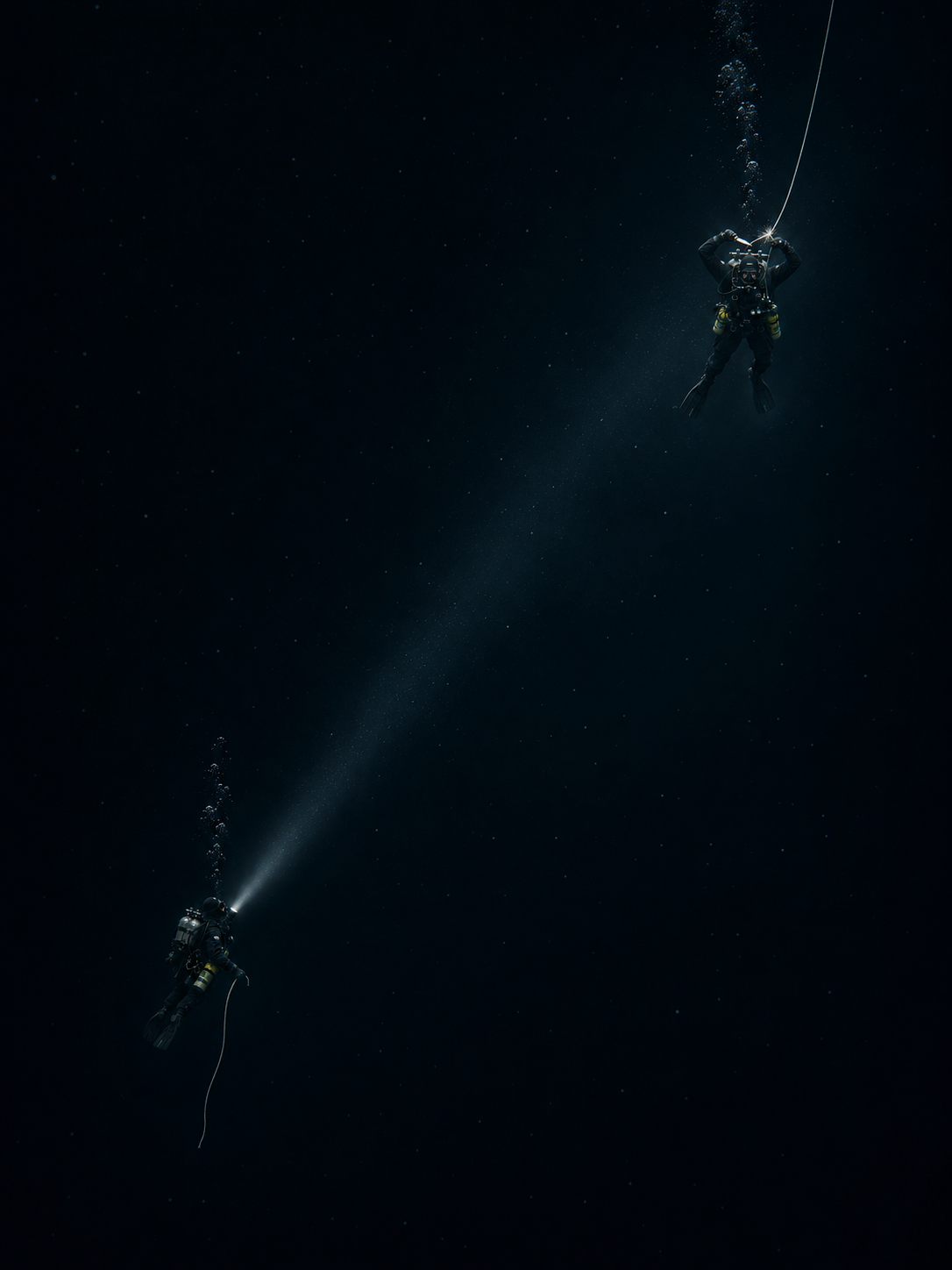
We’d been cut free from the surface, some 200? feet above us, some twelve miles offshore, and we were drifting untethered in the cold Atlantic currents.
We had gone way past the dreaded three Oh Shits.
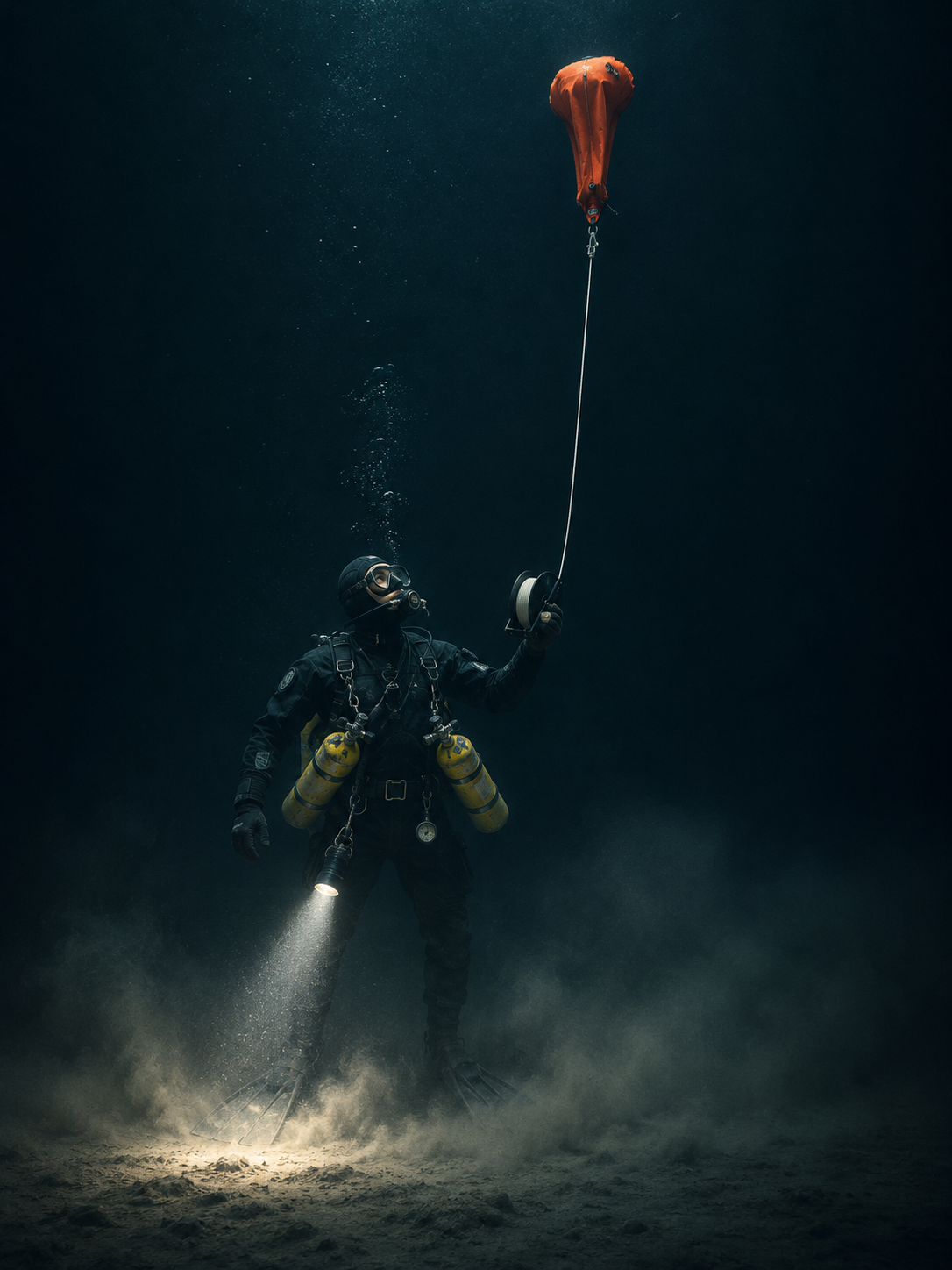
True fear gripped me as I scrambled to pull my emergency lift bag from the pouch at the small of my back, as I frantically worked at unclipping my 400′ primary reel that had become trapped under the two large stage bottles on my left hip.
Struggling in the bulky drysuit, encumbered with all the gear – the lighthead now dangling forgotten from my chest D ring – I wheeled away into the utter darkness. Michael instantly gone. Up and down had lost definition.
A tortured gasp of anguish escaped from around my mouthpiece, almost comical in its high-pitched, helium induced squeak. “We’re dead! We’re f’ing dead! We just died”, I yelled into the void – yelled to myself, to the ocean, to no one in particular.
I hit the button to light up my computer – 190′. A small victory – I was some 90′ off the bottom, had eased my gas consumption by several atmospheres, had slowed the rapid ongassing I’d been experiencing while on the bottom.
The machine had taken over, muscle memory blindly assembling reel and bag, readying it for a shot to the surface – in essence creating my own dropline. All the while the mantra continued bubbling into the water, “We’re dead. Oh man, we’re so dead, but we just don’t know it yet…”
It was then that I felt the tips of my fins sink into something – a resistance that wasn’t there a moment ago – and with a groan of despair I realized I was once again on the seafloor.
Alone – with nothing, no buddy, no line, nothing but an empty field of darkness. Alone in a frigid ocean, 280’ beneath a storm-tossed surface, alone with a rapidly depleting gas supply and a body filling with inert gas.
——
To be continued… (I mean, I hope!)
First off – If you’re new here, you may want to start at the beginning:
All right – welcome back. All this talk and I don’t think there’s been any actual diving yet.
Let me take a quick peek (checks notes).
Nope, no diving. Let’s fix that…
With the dropline set and, with any luck somewhere near the pop-up, it was go time. I gathered the team for a final dive plan review before Michael and I kitted up.
In decompression diving everything needs to be timed to the minute, as both gas consumption and deco obligation exponentially raises at such deep working depths. Hence everything needs to be thought of, and rehearsed, prior to the dive – and contingencies need to be built in in case the dive goes pear shaped. So the plan is everything.
The Plan…
– Drop in the water breathing my travel mix in the small tank hitched to my lift hip and swim over to the turkey ball, where we will meet up and do a final gear check.
– I am lead for the dive with Michael as secondary – so I’ll run down the line first.
– Quick descent along the line to 30′ where we switch from travel mix to back gas (hypoxic trimix) and do an S-Drill (a 360 degree buddy leak check and test breathing off the backup regulator on the twinset).
– I only allotted four minutes for the descent from the S Drill point to the bottom some 280′ down. That’s fast but manageable – and the gas consumption clock would now be ticking
– Regroup at the in-line float at 220′, which has us at 60′ off the bottom, before the final push.
– We only have 14 minutes allotted on the bottom for all activities. At 280′ we’re breathing our gas supply at a rate of nine times what we would be breathing at the surface, so we’ll be sucking the tanks down fast.
– Once at the bottom I’ll unstow the lift bag attached to the anchor and give it about a 1/3 fill. This is to aid in the retrieval of the dropline after the dive – as while the line is hauled up ambient pressure reduces and the bag fills, giving increasing lift to the anchor – but not too much to inadvertently send the anchor – and our lifeline – to the surface. That would be very bad.
– Michael will attach his strobe to anchor shank – this will be our reference beacon.
– I’ll hook up a hundred foot reel of line to the anchor. This is our search line for radial patterns around the anchor. Again – pitch black and a silt bottom – the dropline is life, never disconnect yourself from the dropline…
– Pay the line out ten feet, do a 360 sweep as a buddy team – maintaining physical contact – pay out another ten feet, repeat. Keep going until either we find the pop-up transducer or we hit 12 minutes of bottom time – at which point it’s time to pack it up and get the hell outta Dodge.
– In the eventuality the pop-up is found Michael will attach the lift bag he has in a pouch mounted to one of his deco bottles and shoot the unit to the surface. This lift bag is brought specifically for this purpose.
(Note: In addition to this bag, we both carry two lift bags each. These are used for emergency contingencies and are not for the mission.)
– Regardless of success we have to be moving up the line after a maximum of 14 minutes of bottom time.
– From there it’s the tedium of running deco. The water temp at about 38F, and even wearing heavy snowsuit-style undergarments under the drysuit, the cold really seeps in on longer dives. This is especially true during deco where you are specifically trying to not exert yourself. Each stop – which for this dive begins at 190′ – seems to last an eternity. Not to mention the stops progressively get longer the shallower you get.
– For emergencies / safety, I had a diver on standby, in a drysuit and gear set up, aboard Daybreaker. The Lophius was nearby acting as spotter in the extreme case Michael or I lose the dropline and are swept away in the Atlantic currents. Of course there’s the usual O2, First Aid kit, and AED aboard, and all the backup / emergency gear Michael and I always carry.
That’s the plan – simple as Sell underwear, Make money.
Plan the Dive, Dive the Plan…
So that’s the plan – now it’s go time.
Daybreaker was pitching and rolling beside the turkey ball, the boat was really moving in the post storm swell and fetch, adding challenge to the already challenging process of getting kitted up.
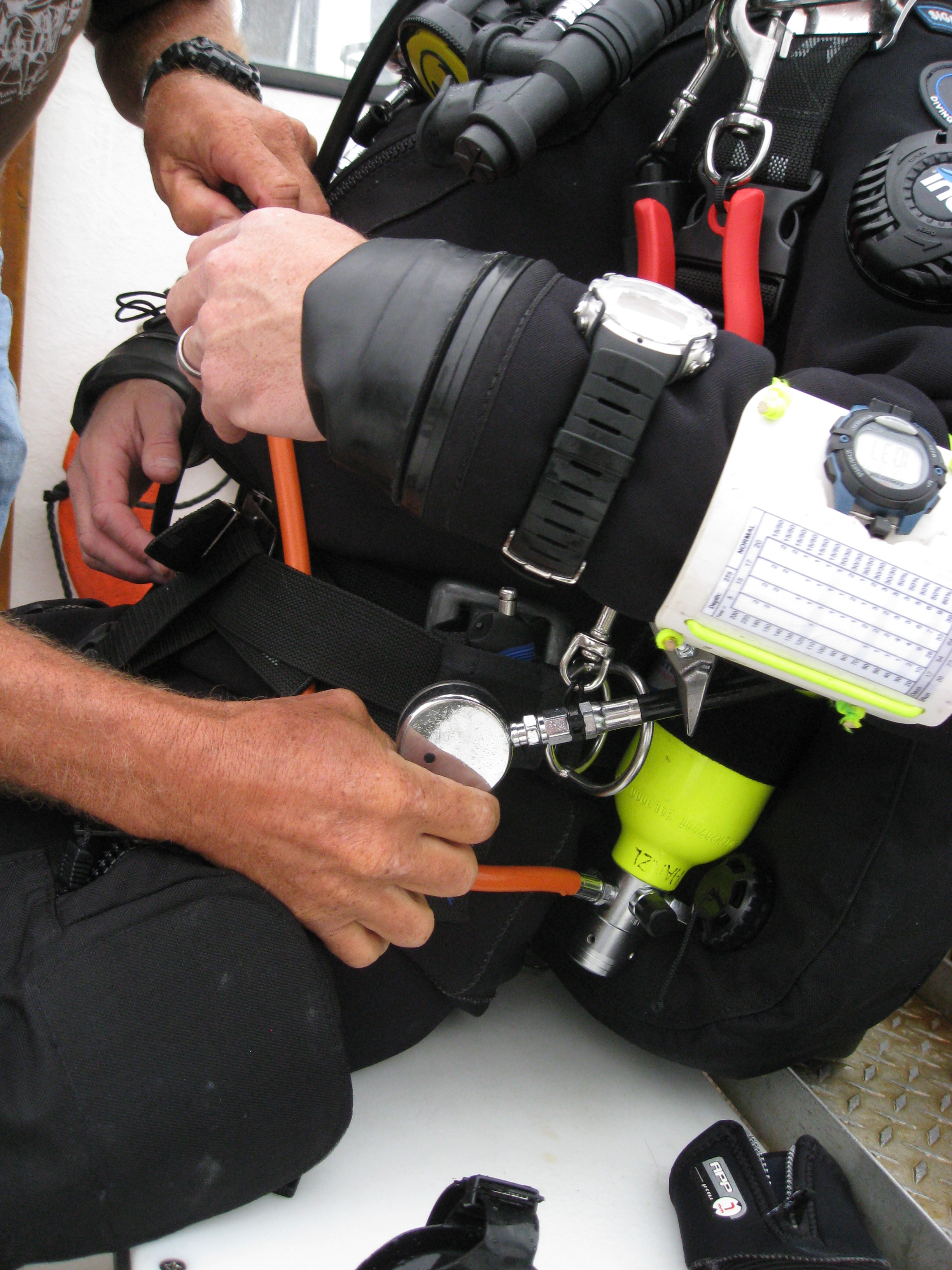
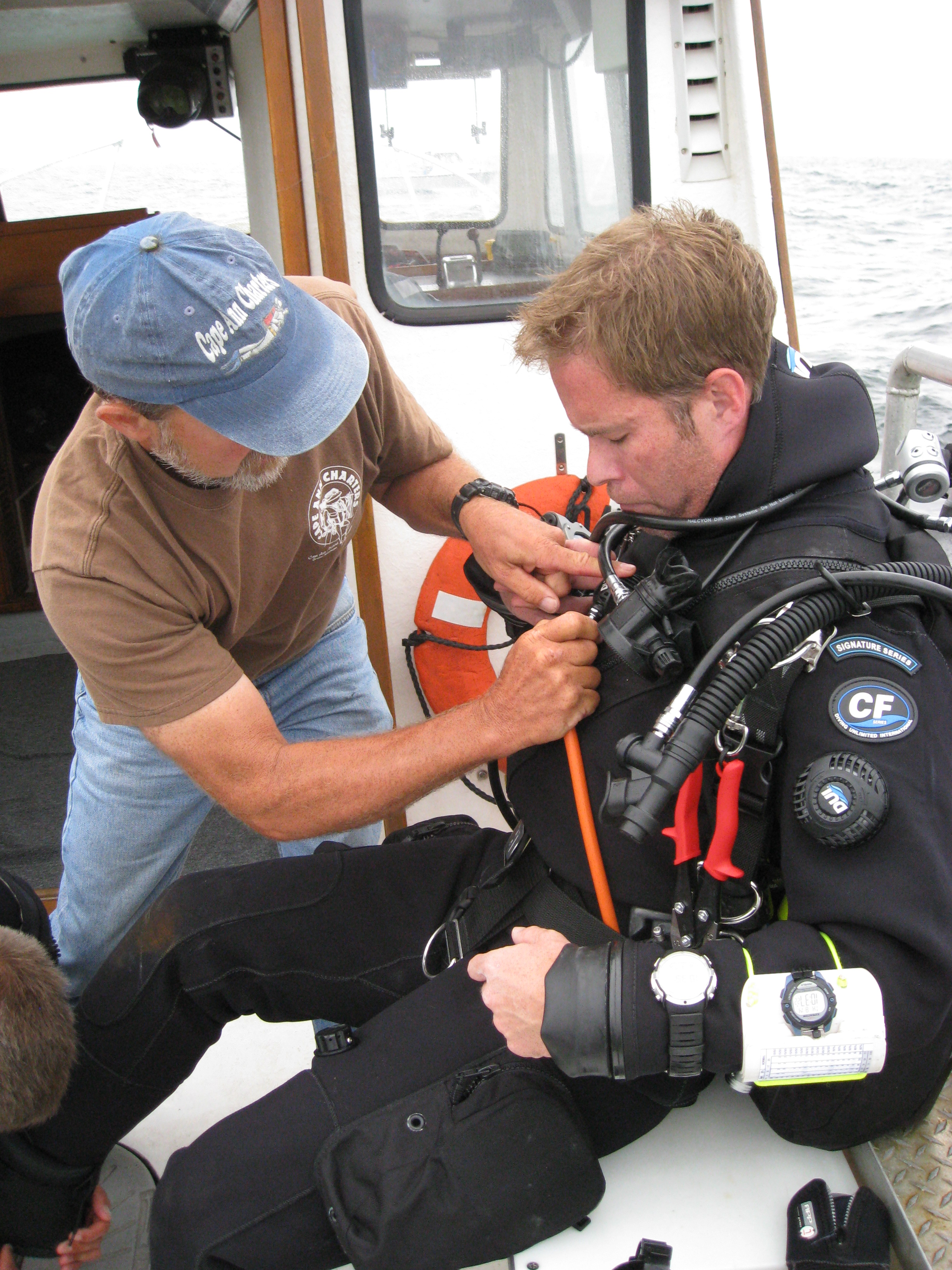
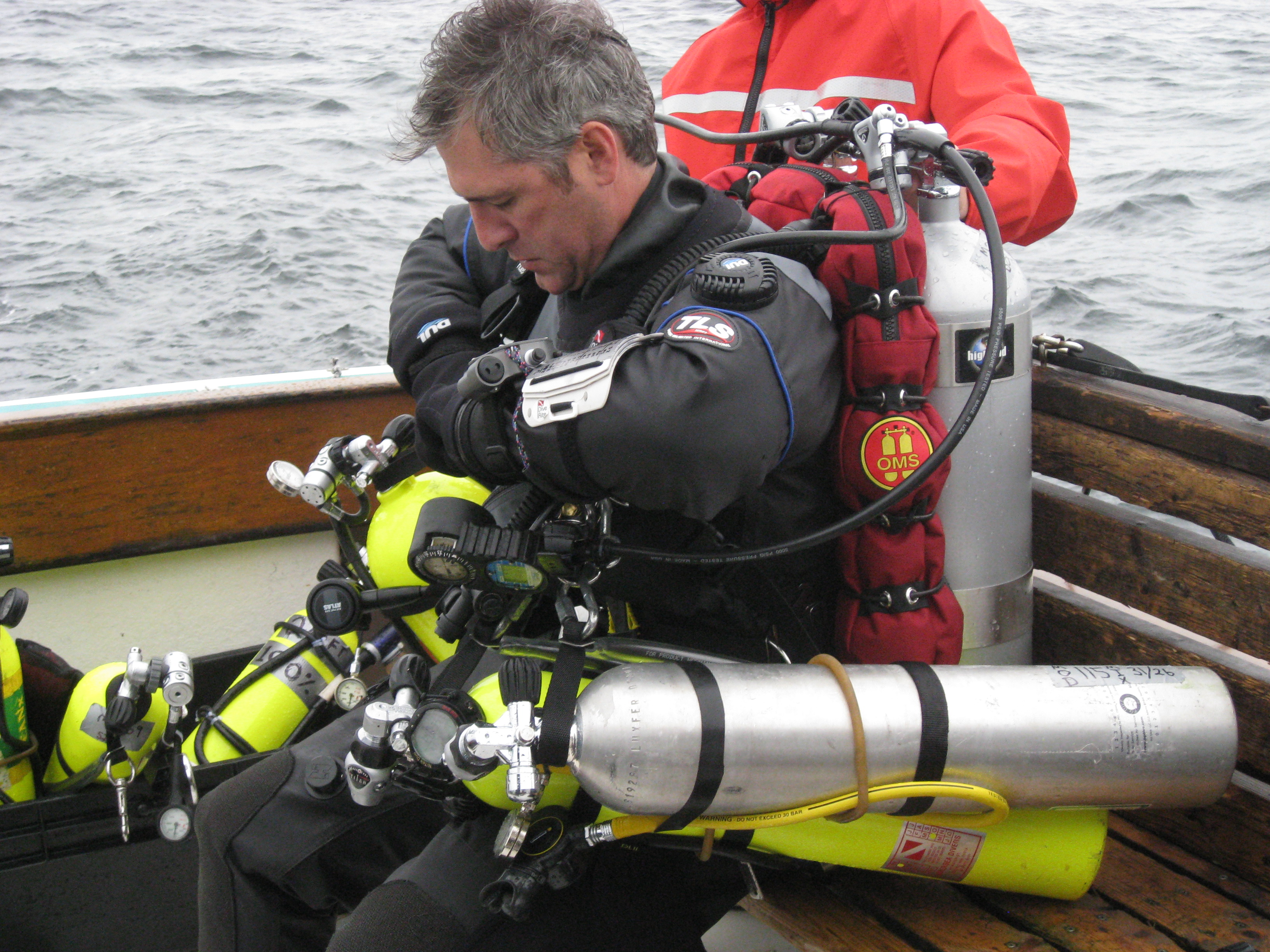
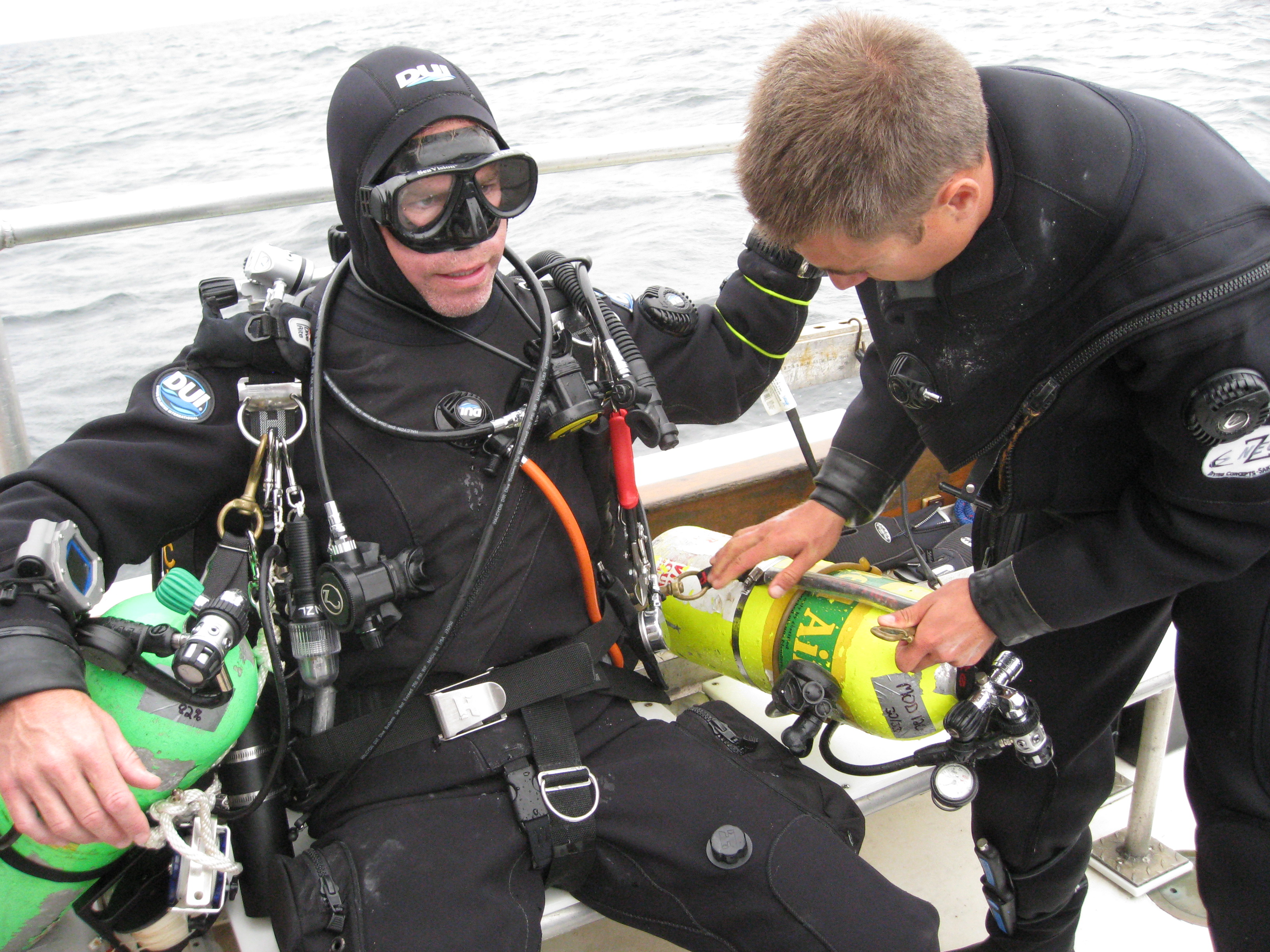
You don’t don this gear like you would with recreational scuba gear, rather you have to climb up inside the harness with it still hooked to the boat. The harness is continuous weave – meaning there’s no quick disconnects to break. If your harness fails then your entire kit, with all your gas (you know, that stuff you’re breathing), falls away from your body and it’s gone. There are tales of this happening to some poor hapless tech divers who paid for the mistake with their lives (my deco computer, when it boots up, says, “Check your wingnuts you idiot!”).
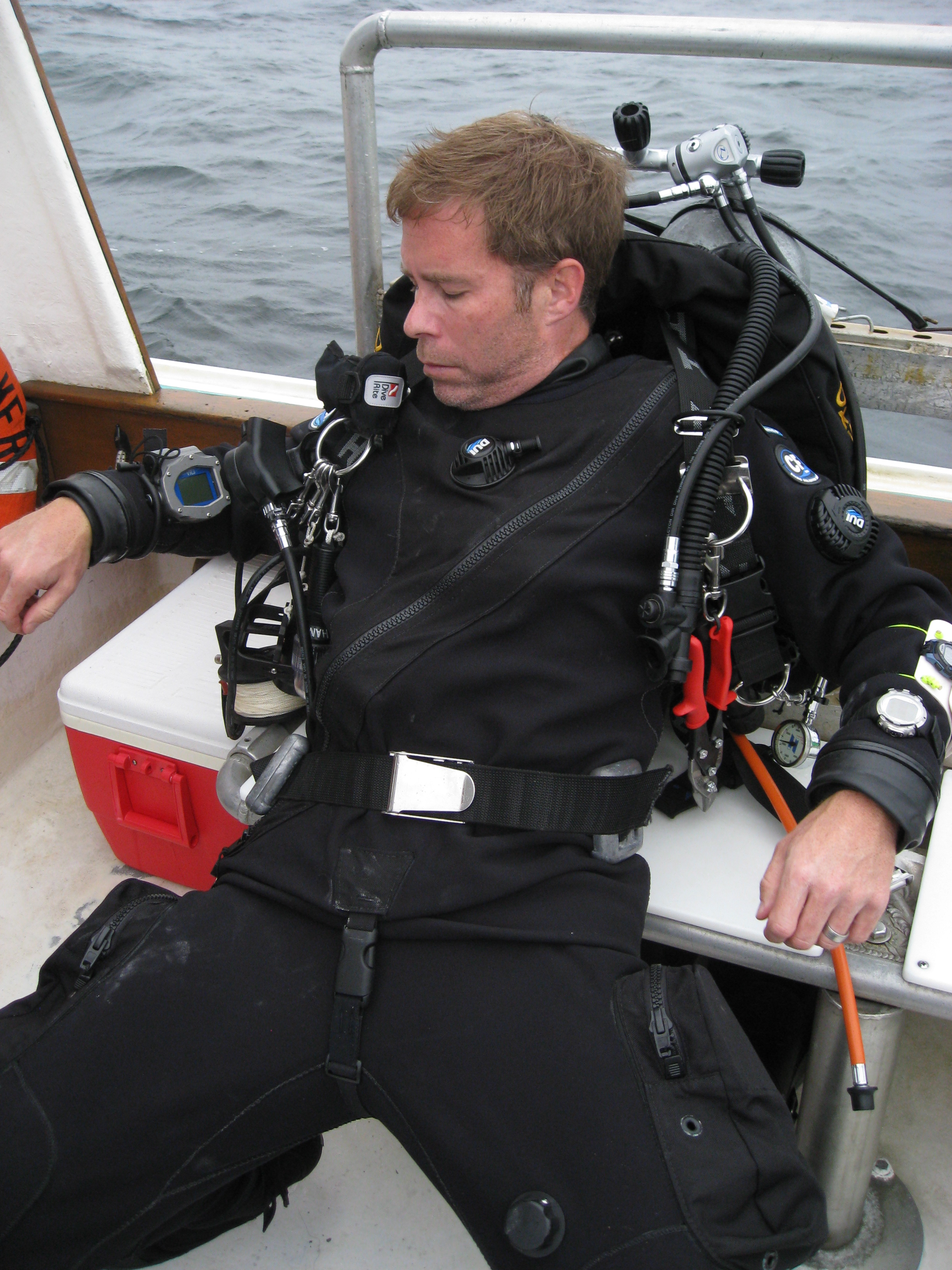
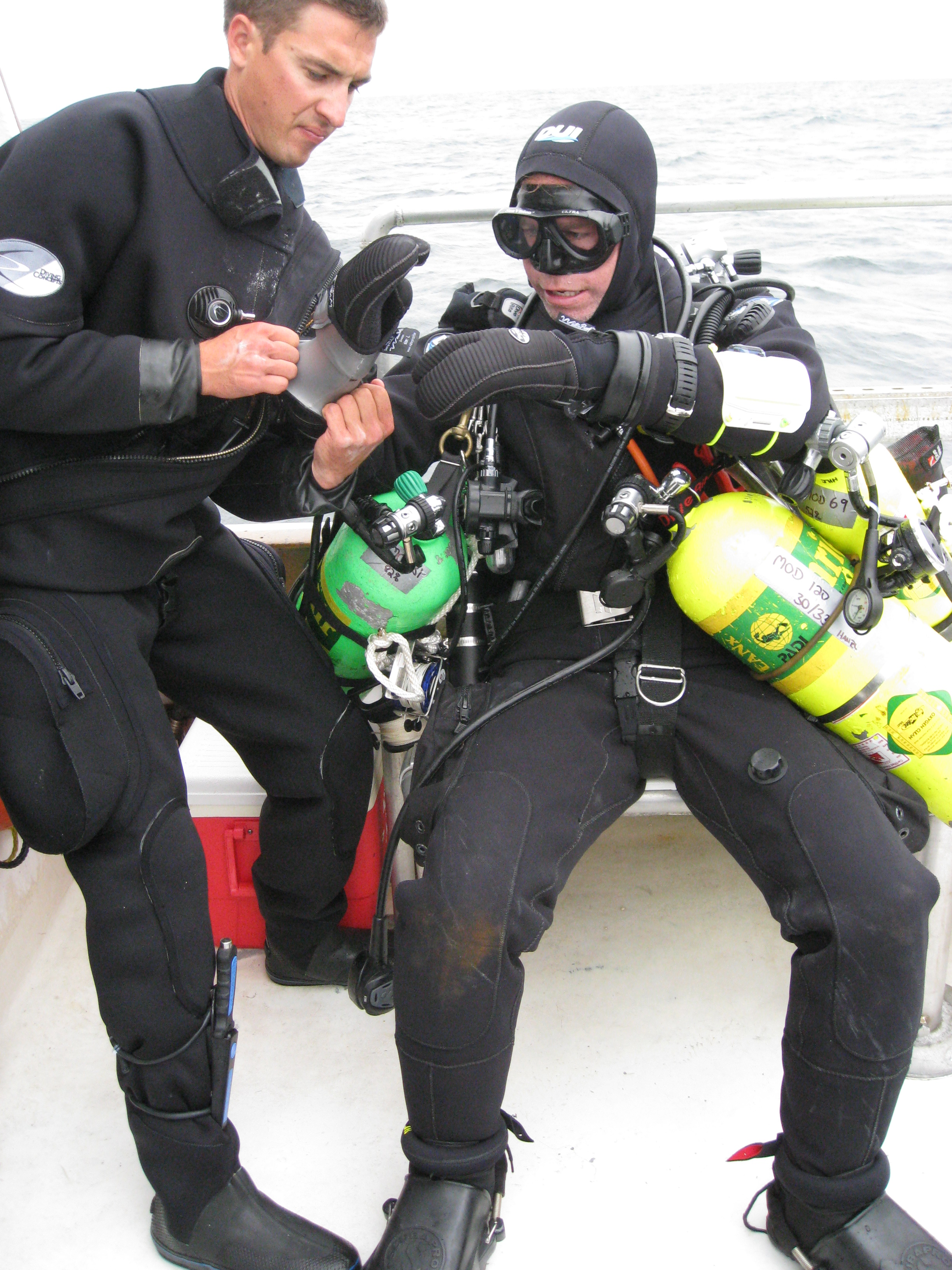
Once in the harness the safety diver (Matt) assists in the rest of the process, including clipping on all the additional deco tanks per my specific config, hose routing, helping get the bulky gloves on, and stuffing my feet into my fins – there’s no way I can reach them once in the harness. It takes a village…
The Dive…
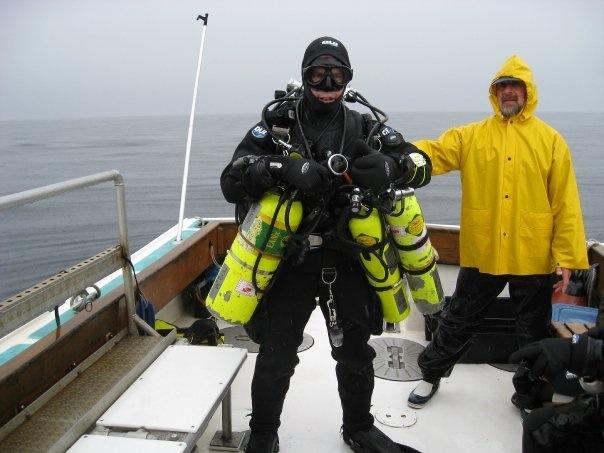
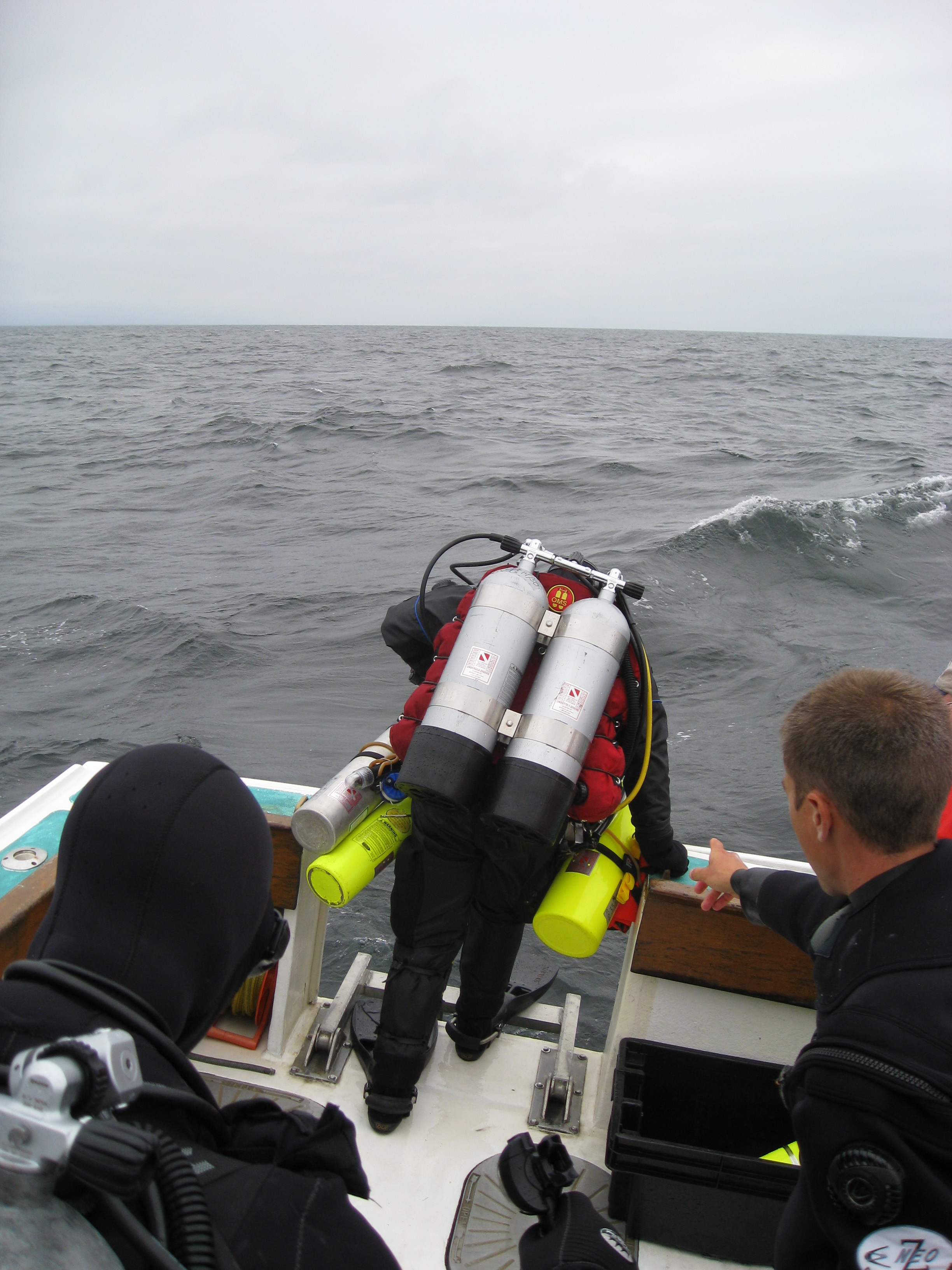
Entering the water with all this kit on is more of a somewhat controlled fall. With Matt’s help I stagger up and shuffle to the stern. As Daybreaker settles into a trough I step off the boat…
With the terrible surface conditions even the entry and surface swim to the ball, with 150lbs of gear trying to drag you under, was a real chore.
Meeting at the float Michael and I immediately descend to our planned stop at 30′, anxious to get away from the surface swells. Collecting ourselves at the stop I notice my dive computer’s backlight is timing out, requiring a button press to light it back up. This can be changed, but when in dive mode it’s a little complicated, and I chose to ignore the issue.
Again – are you counting? The Three Oh Shits are already stacking up.
The clock was now officially ticking and after the S Drills were completed I flash Michael an OK sign and turn down the line. So began the rapid descent into darkness. As I let the increasing pressure around me compress the gas in both my drysuit and the dual bladders of my BCD, my rate of speed rapidly ticks up. This is the part of the dive that you sort of zen out – you begin an automatic circle of activity. Equalize your sinuses, add a burst of gas into the BCD, add another slug into your drysuit to equalize against the squeeze as the increasing pressure compresses the gas in your suit, check your depth and time – then rinse and repeat. All the while the line is whizzing through the circle you make with your thumb and forefinger.
The particulate green murk the dive started in began deepening into a velvety black. There was absolutely nothing to see save for the white line paying though my fingers. The muted thunder of my exhales was my only companion, reminding me of how quickly I was bleeding off the precious lifegiving gas.
My primary light is a big cannister light, the battery pack strapped at my right waist, its umbilical running up to the light head I keep clipped to my right shoulder D ring. Its light forms a fairly narrow beam (8 degrees), deliberately soft at the edges and laser sharp in the center for light signaling. Dangling off the D ring, the downward beam fades into nothingness, save for the white line I’m riding along.
That damn deco computer backlight though. I can’t see the display without tapping a button – and with one hand riding the line (my computer arm) and the other occupied with my circle of activity, I had little bandwidth left for activating the screen. I’d lost some situational awareness, including my depth, and that’s wasn’t good.
(The quiet “oh shits” lingering at the back of my mind were slowly gaining a voice).
It wasn’t long into the descent – perhaps a minute – when I realized my breathing wasn’t normal. I was gasping in large jerky breaths and my head was pounding. But beside the backlight issue everything seemed in order. Still, this wasn’t good – I was keenly aware of the strict gas limits imposed on the 383 cubic feet of gas I was carrying. This consumption rate wasn’t part of the plan. I had to get my breathing under control.
Then a realization hit me with a shock – the line paying through the circle of my fingers was now running against the underside of my forefinger. Meaning – it was no longer running straight down, rather it was travelling at a distinct non-vertical angle.
A heartbeat later and the line was horizontal. The vertical dropline, that ran straight down to the bottom, was now freekin HORIZONTAL! Another rapid heartbeat and the line was tugging at top of my finger, heading UP!
UP???
What was my depth? Where was I in the water column? I had no idea – glancing at my wrist, an action that typically always provided the crucial statistics of my dive, revealed nothing but a dark chunk of metal.
As I struggled to make sense of this, and to get my runaway breathing under control, thoughts were exploding in my head. What if the dropline had caught on one of the massive mile-long anchor rodes from the STL? Was I about to smash head-first into a massive steel link the size of a Mini Cooper? Something was terribly wrong.
I jammed the brakes on my head-first descent and grabbed the handle of my light head so I could signal up to Michael that I was calling the dive. As the glow of his descending form took shape, I steered my light over towards the descent line, which now formed a U, my fingers at the bottom of it. Just then understanding dawned clear, as clear as the light that revealed the in-line float hovering some feet above my head.
The dropline had formed a sideways S curve, pulled into this shape by a combination of excess line, the weight of the line, and the float pulling the last section of line taught against the anchor. I needed no computer to tell me where I was – I was at 220′, just 60′ off the bottom. Yes!
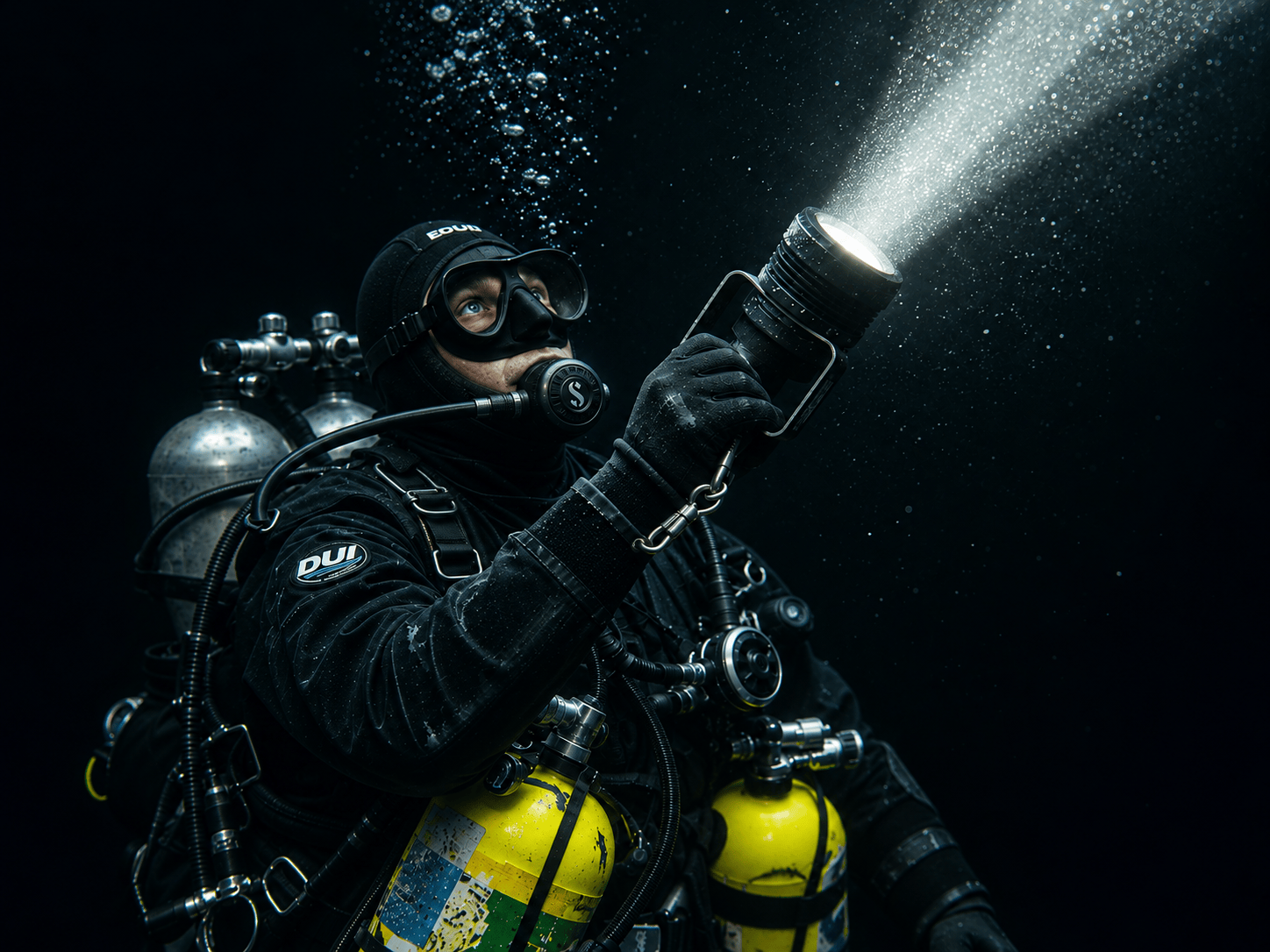
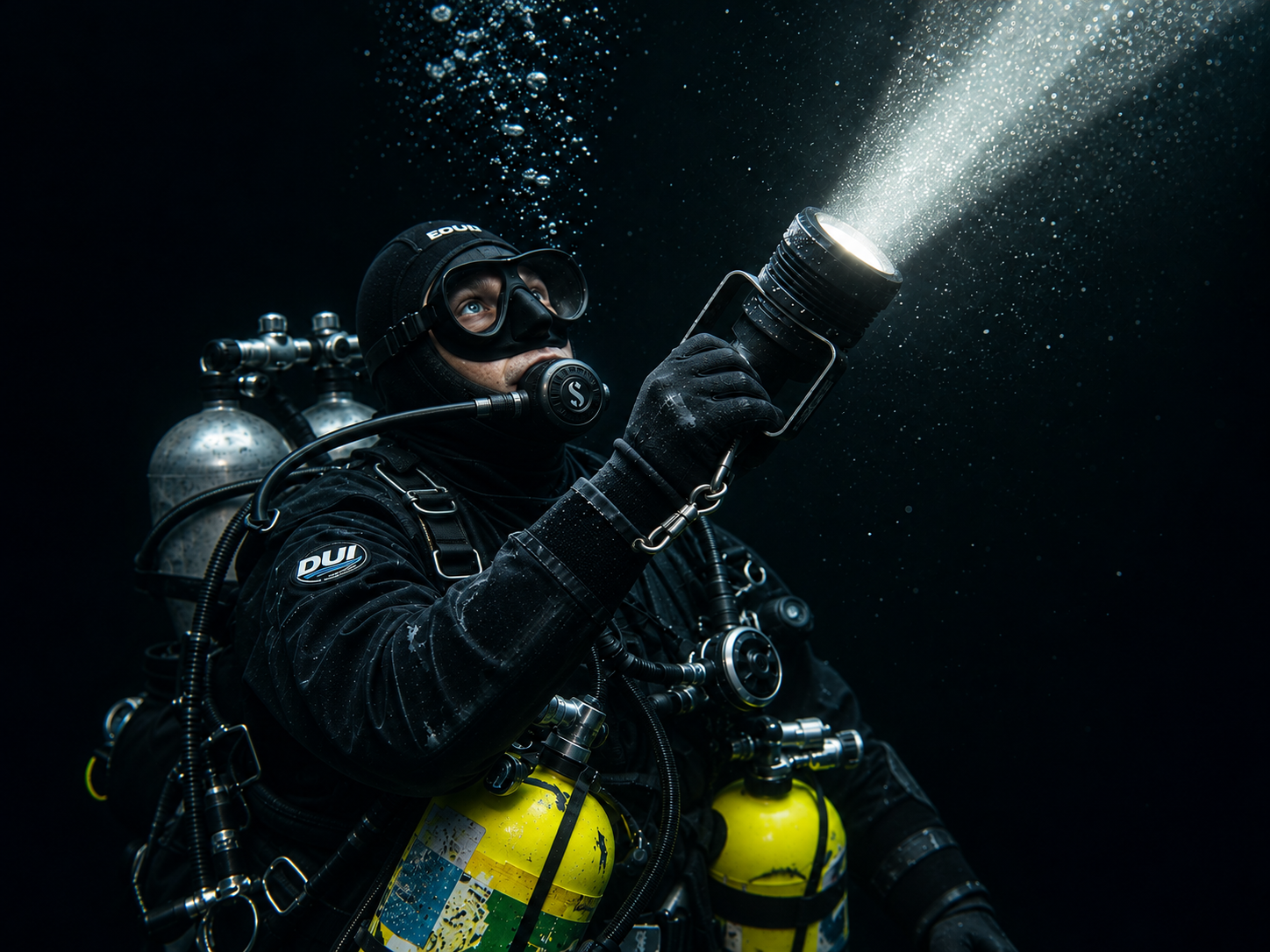
OBVIOUS NOTE: Stupid me – I didn’t take any pictures during this leisurely dive, so I’m using my friend ChatGPT to help with some visualizations.
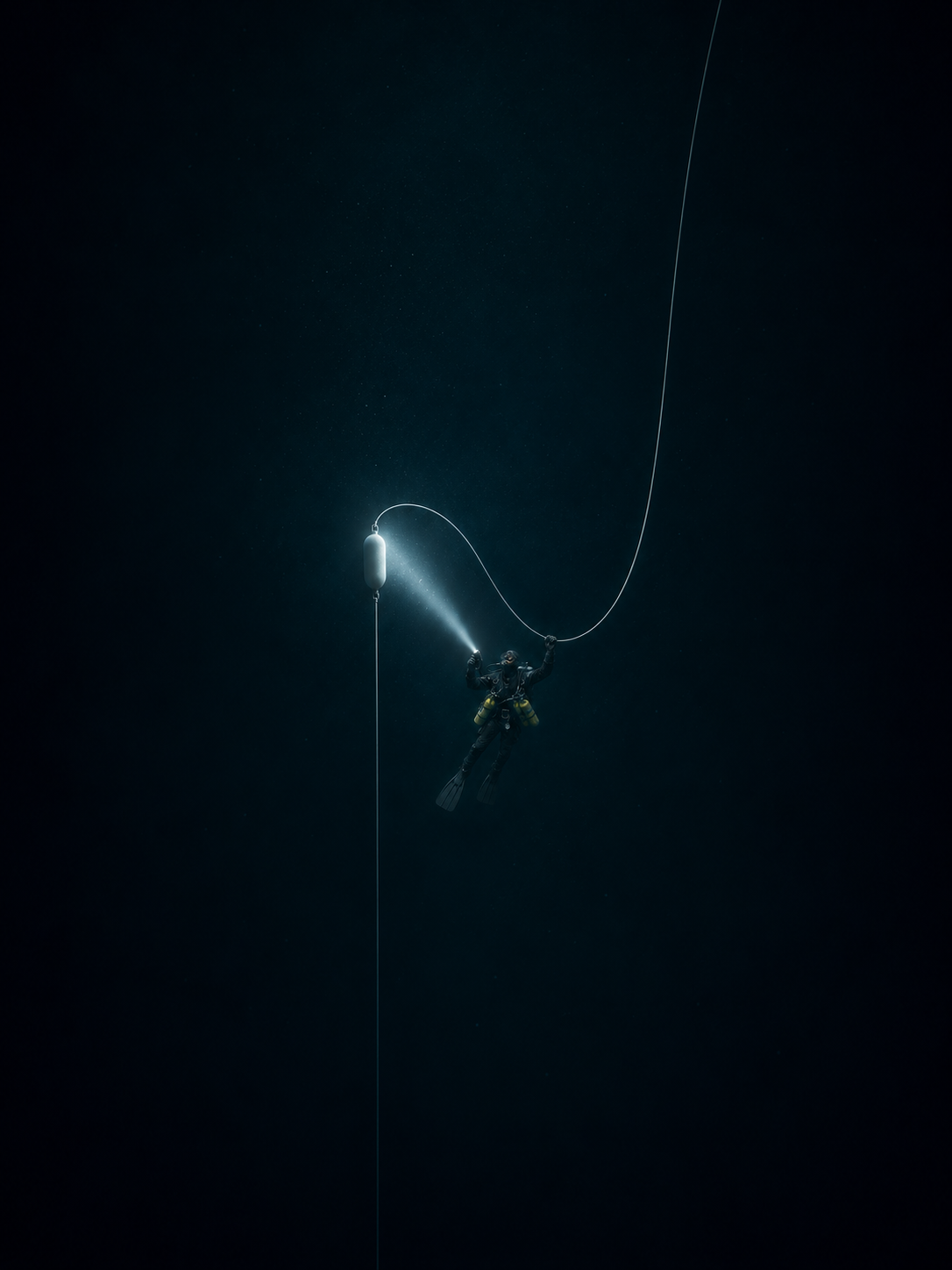
I released the light to hang back off its D ring, transferred to the part of the dropline below the float, and quickly descended the remaining 60′ to the anchor. Feathering my descent, I stopped at a hover just a few feet off the silt bottom. With a modified frog kick so as to not to disturb the endless muck, I pivoted in a slow circle and surveyed my surroundings. Without disturbing the sediment drape the visibility was amazingly good and I could look out at the expanse of grey spreading out from the anchor in every direction. An uninterrupted, featureless expanse – an endless monochromatic desert.
The clock was counting – how much extra time did that descent take? I knew it was way more than four minutes. Damn backlight. Damn dropline!
I played my light around the anchor of the dropline, nearly completing a full circle.
Tick, tick. The clock was counting – where was Michael? I had left him maybe a hundred feet above me. He should be here by now.
The light continued its journey. My breathing now back under control.
Featureless grey – depressing grey – nothingness.
Wait – what was that? A flash of red briefly caught the edge of my beam. I swung the light back. Red? The pop-up has red floats attached to it… Red!
The pop-up! There – not thirty feet past the anchor lay the unit. Stunned – I had absolutely no faith we’d actually find the thing and here it was. With just a few frog kicks I could easily swim over and grab it.

I left the line – the object of the mission laying right before me. In a few kicks I crossed the 30′ or so and was there, digging it out of the silt, giddy with excitement.
Then it hit me – I had left the line. The acoustical pop-up in my hands, I was immediately engulfed in an impenetrable cloud of silt.
And I was simultaneously engulfed with a crushing sense of dread.
I had left the line…
OH
SHIT!!
——
To be continued… (again!)


If you need a refresher – I recommend starting at the beginnning:
Oh Shit!!
I think that’s where I left off. Let me go back and check…
Tale of a Really Bad Dive – Part 2
Yep – Oh Shit!!
This dive has already taken a turn for the worse, though I didn’t realize it at the time. Not even left the marina and I’d already used up the first of my three available oh sh*ts.
So strap in, its going to get a bit rocky…
7:00am Aug 13th has us rolling out of Gloucester, MA aboard the dive vessel Daybreaker. Aboard is my buddy Michael, NEAq scientist Randi and one of her interns, a safety observer from Excelerate Energy, a safety diver, Captain Fran and his mate. The skies were overcast and blustery. A storm front had rolled through overnight and it was rough, even by northeast standards. Too rough in hindsight (are you counting?) but I had rolled the dice and, you know – plan the dive, dive the plan.

An hour and a half later Daybreaker rendezvous with our security escort, the 124′ patrol ship Gateway Endeavor, at a nondescript patch of grey ocean some 12 NM east of Boston. An hour and a half of getting beat up by the 5 foot plus, tightly stacked seas, while Michael and I turned inward as we mentally ran through the plan – and, speaking for myself, dealt with the usual stomach churning stress that always precedes a big dive.


Meanwhile the little Lophius was battling her way out of Boston Harbor. The small craft advisory most definitely applied to her, but she’s a hearty Eastern hull and is used to taking a pounding. Unfortunately JD didn’t fare as well (as I later found out). One particularly aggressive wave sent him airborne, striking his head on the hardtop, causing a pretty nasty gash. But he and Barb pressed on.

As we waited for the Lophius to arrive on site we set up the Interrogator and started running a search grid, using the interrogator to ping the pop-up whose GPS coordinates we had targeted. As Daybreaker continued running passes topside, the pop-up, laying some 280’ on the seafloor continuously reported back distance readings between it and Daybreaker . The numbers steadily ticked off on the Interrogator’s display – 400′, 390′, 380′,…,280′, 290′, 300′, 310′ – with me feeding Captain Fran course corrections until eventually I was somewhat confident the device was beneath us – or thereabouts – and ordered the dropline to be deployed. But it was basically finding a needle in a haystack.

Okay – sidebar. Dropline. What’s that?
When decompression diving, in open water and subject to strong currents, it is absolutely critical you have a vertical line that you descend on, and more importantly, that you decompress along during your painfully slow ascent. Your dropline is literally your lifeline to the surface – you protect it like it’s your own child. You lose it and, well, not to be a broken record but, you can very well lose your life.
Referring back to my Andrea Doria dive, there’s a bit where I describe using a dropline in greater detail. I’ve been told I’m really wordy, so for those in that camp, here’s a direct link to that section of the video…
For this recovery attempt the dropline was not only our safety line, but was also the guide to our target – we hoped. The pop-up lay on a featureless bottom, an endless sediment drape that once touched becomes an impenetrable silt cloud that no light can penetrate. I knew the bottom features completely because a month earlier the Aquarium had contracted a company to send down a ROV to see if it could locate the po-ups. Though it failed at that task, the video it recorded gave me a pretty grim visual of what to expect on the bottom. Compounding that, at 280′ in the northern Atlantic, there is absolutely no light – it’s so pitch black its oppressive. There is nothing for reference – no up or down, no left or right – just choking darkness. We needed that line – and my placing it at the right spot – to find the pop-up.
So prior to dive day I asked Captain Fran assemble a dropline – specifically a 300′ length of 3/8″ nylon line, with a turkey ball (a large round float) at one end and a 50lb mushroom anchor, with a rolled-up 80lb lift bag attached, on the other. Additionally, I asked him to install an in-line float such that it was 60 feet “up the line” from the anchor. The line was cut to 300′, rather then the expected 280′ depth, to allow for wave and tidal action, but this would mean the descent wasn’t a straight drop to the bottom. Therefore the in-line float was to ensure the last 60′ to the bottom was a straight run down.
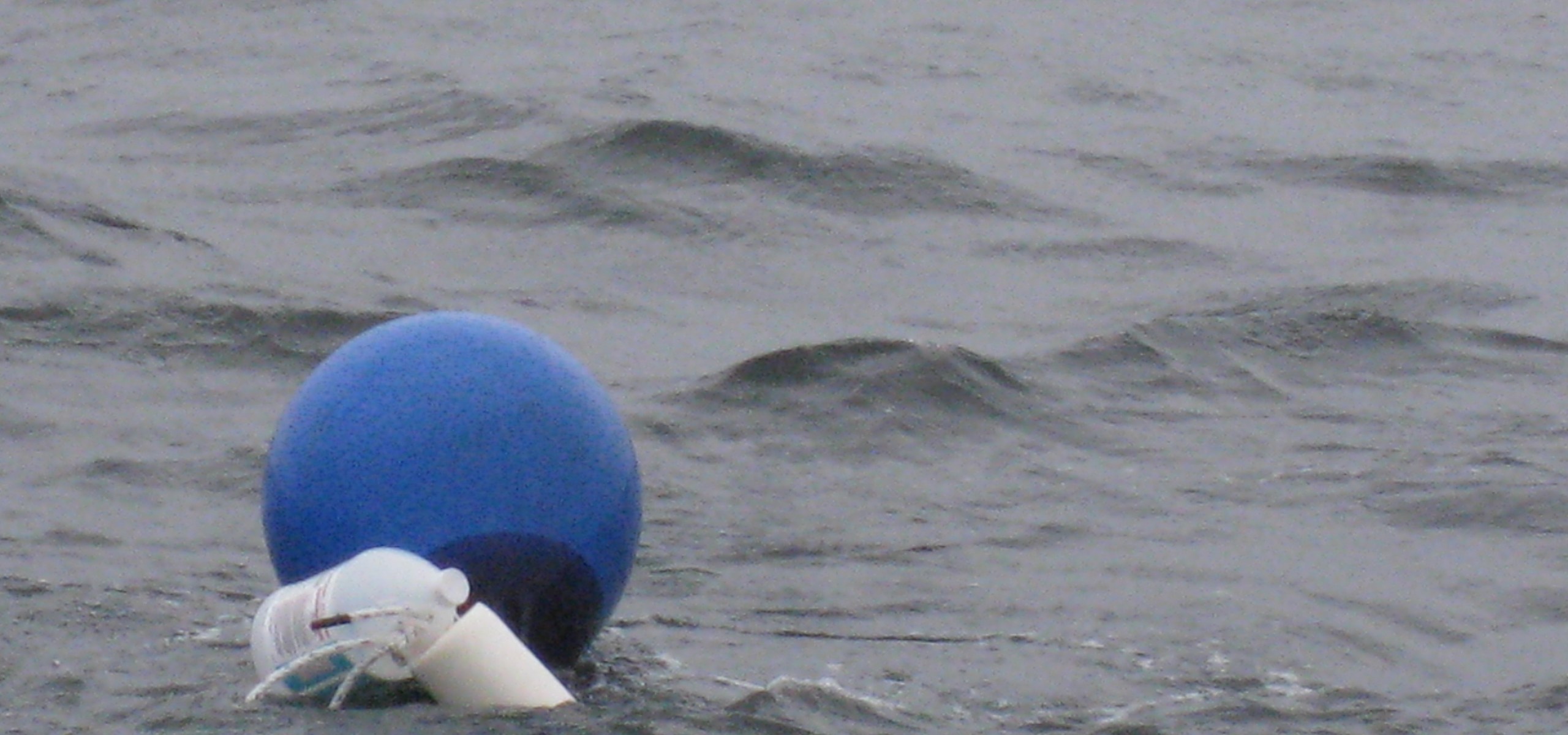
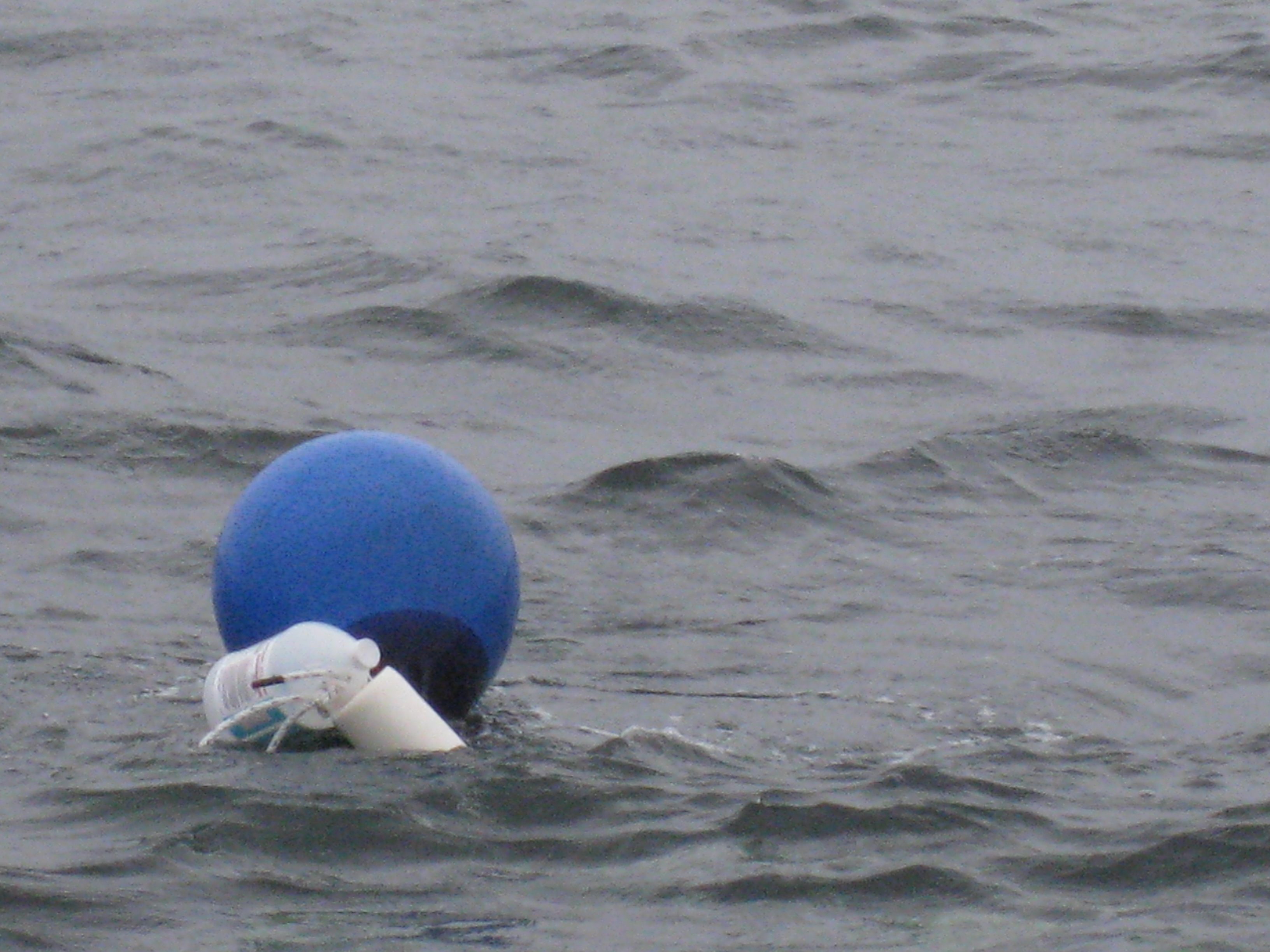
Right – back to the dive. Once I was happy with the boat’s position I had the dropline’s anchor tossed overboard, the line paying out from a tote on the boat (LOL, that sounds funny) until the turkey ball unceremoniously followed. There, bobbing in the rather intimidating seas, floated a blue ball that looked so innocent but, unknown to me, represented a really bad dive that I wasn’t sure I was going to survive.

——
As always, questions and comments always welcome!


First off, as you may have noticed in the title, this is Part 2 of this story. So unless you’ve already read Part 1, or you’re the type of weirdo who likes starting a series in the middle, you may want to back up a tic and read this first…
Okay, so where was I…?
Oh yeah, researchers from NEAq had lost four acoustical popup transducers on the seafloor, 280′ beneath the surface at the Northeast Gateway LNG deepwater offloading port. The “popup” part pf the system didn’t work as planned, and I foolishly said I could get them…
In a nutshell (heh, I guess in a way you could call my drysuit that, especially if I didn’t equalize during descent and got a good squeeze…) my plan was simple. Go to the GPS coordinates for one of the transducers, use the Interrogator to ping the targeted popup, position the boat so the range reading to the popup matches the depth, chuck in a specially made dropline, descend this line, and find and retrieve the unit.
Easy peasy.
But not so easy.
Welcome to the wonderful world of technical diving, where pretty much everything tries to kill you, including your equipment. If I had to define what’s the overarching difference between tech diving and recreational diving, I’d say it’s that recreational divers can solve their problems on the surface, where technical divers can’t…
For starters, I should mention a few things about diving to the depths, and at the temperatures, involved in a dive like this recovery attampt. And note – all of these things will come into play during this dive.
For every atmosphere (33′ seawater) of depth, gas consumption (I say gas and not air because I never breath air during this kind of dive) relative to breathing on the surface goes up as a multiple of the number of atmospheres you’re under. So a dive to 280′ means nine atmospheres , so every breath I take is like breathing nine breaths on the surface (for all intents and purposes), and therefore my gas consumption is nine times faster.
Another issue many may not realize is that the oxygen found in air becomes toxic to humans at roughly 212′ (this is a rule of thumb, effected by temperature, conditioning, stress, workload, etc). What does this mean, you ask? Well, this type of toxicity effects your central nervous system and can lead to involuntary convulsions, with absolutely no warning. And convulsing under water is something to be avoided – you could spit out your breathing mouthpiece and drown, as an example. Suffice it to say, breathing air past 130′ starts to become risky with regards to oxygen toxicity, which is one key reason why 130′ is considered the depth limit for recreation divers.
Great – so air’s not an option for deep dives.
So what DO you breathe at 280′? Well, the simple answer is you reduce the percentage of O2 until its partial pressure at the target depth (280′) is 1.3 atmospheres absolute (ATA). This works out to around 10% O2 at 280′. But oh, guess what? You need, at minimum, 16% O2 at the surface to maintain consciousness. Meaning, what you breathe on the bottom, known as your “bottom mix”, can be deadly to you on the surface. Jump off the boat with a nice full tank with10% oxygen, exert yourself swimming towards the drop line, and voila! You pass out and drown. Great… So you need to start the dive breathing another tank, one with enough O2% to keep you un-dead. This one is known at your “travel mix”.
But that’s just scratching the surface. I won’t go into all the nitty details (though I do love talking about this stuff!). Summing it up, to dive to 280′ I need the following tanks:
(SIDE NOTE: This all pertains to open circuit diving – dives where you have individual tanks that you breath off. I have since switched to rebreathers, which is basically your own “gas mix bartender”, allowing you to dial in the ideal mix continuously.)
– A set of double 100 cu ft tanks on my back (200 cu ft total), connected together with a three valve manifold. This “back gas” is my bottom mix. These tanks have two completely independent regulator sets attached for redundancy. This gas is a 10/50/40 mix – 10% O2, 50% He (helium), 40% N2 (nitrogen) – and is called “10/50 trimix”. Trimix meaning, you guessed it, a mixture of three gasses – oxygen, helium, and nitrogen.
– A 40 cu ft tank of “travel mix” of 30/30 trimix (so 30% O2, 30% He, the remaining balance N2) . You start the dive on this tank because at 30% O2 it’s good to breathe on the surface, and it’s also the first deco gas to use on way back up.
– A 63 cu ft tank of 50% nitrox (no helium, so 50% O2, 50% N2). Regulator pressurized but turned off. This is the second deco gas. (I’ll leave it to you to sort out why the reg is pressurized then turned off.)
– A 80 cu ft tank of 80% nitrox. Regulator also pressurized and turned off. This is the third deco gas.
-Oh, and since my back gas is trimix, meaning it contains helium, I can’t use it to pressurize my drysuit, because helium is a tiny weenie little molecule and is a terrible insulator. So guess what – you need yet another tank, in this case a 6cu ft tank of argon that is plumbed directly into my suit. And a drysuit is an absolute requirement – the water temperature during this dive got down to 36F, and you are down there for a decent amount of time.

Speaking of cold ass diving – you may want to check out this video of some ice diving I did a while back.
Did I mention decompression? Yeah, that’s the name of the game in tech diving. And deco takes a long time, with many stops and several gas switches along the way, to get you back to the surface. Ascend a prescribed amount, stop at a specific depth, turn on your next gas, purge reg, remove current reg, put in new reg, shut off and stow old reg, rinse and repeat. But NO NOT CHANGE DEPTH! Ascend too quickly and you fizz. (fizzing is bad – don’t believe me? Check my Personal Experience with Getting the Bends)

Oh, and grab the wrong reg by accident (it is, after all, pitch black and you can’t actually see the gear stowed around your body regardless) and you can O2 tox, or you become hypoxic. And then you die…
I know, I know, it sure sounds like I’m being dramatic with all this hyperbole. Sadly I’m not – this particular activity is constantly claiming lives. There’s something known as the “Three oh sh*ts” rule. You may survive the first, and even the second, but very rarely will you make it out in one piece after the third. Generally speaking, the first one most often happens even before the dive has begun, and by then the course has been set.
On this dive I had my three “oh sh*ts”…
Did I mention isobaric counter diffusion? If you switch between a high helium concentration to a much lower one (for example, from the 30/30 trimix to 50% nitrox which has zero He) you run the risk of rapid gas exchange due to a high gas pressure gradient – aka, you can get bent without changing depth at all.

Right, enough about the boring stuff.
Let’s get back to the dive…
For this dive NEAq had to get security clearance from the operator of the deepwater port, Excelerate Energy, who also required an observer to be on board the dive boat. We would also be shadowed the entire time by the 124′ patrol vessel Gateway Endeavor. I had contracted technical dive boat Daybreaker to be the dive platform and scheduled NEAq’s dive boat Lophius as a chase boat. This dive required a ton of coordination among many assets and people’s time, which in turn gave me a very tight window of opportunity – and a lot of stress.
Speaking of people – in my job at the Aquarium I oversaw about a 100 person team of divers, but there was only one person who had the specific skills and experience to be my buddy on this dive. Michael. He was a volunteer diver at NEAq and my long time technical dive partner – we’d trained together for some five years for this kind of diving and had executed similar profiles in the past. He’s the guy I did the Andrea Doria with and we knew each other’s skills, reactions, and behaviors like they were our own. He once cut me free from a drift line in the wreck of the YF-415 at 240′, so I owe him that…
You can check out some interesting details of the YF-415 here.
So I set a date of Aug 13th for this dive and had about a month to get everything set up. Mike and I conducted dry rehearsals, walked through every step of the plan, and worked on blind muscle memory for where each specific bit of gear was located on our own rigs, as well as that of our buddy’s.
As the days progressed towards the planned dive, the New England weather steadily turned worse. An offshore storm was brewing and the seas off Boston Harbor were building. The deepwater port lies some 12 nautical miles east of Boston Harbor and when the wind gets up in any direction other than west it gets rather, um, lively.

But there was very little schedule wiggle room with so many pieces in play – if I lost this window it might not happen at all for the rest of the year. The weather was only going to get worse as fall progressed, and it was doubtful if the batteries in the popups would survive the winter.
The evening of the 12th arrived and I made my decision. We were going to do the dive.
6:00am the next morning found me at Daybreaker’s dock in her home port of Gloucester, MA, where I met up with Captain Fran, his deck hand, a safety diver, my dive buddy Michael, Randi – one of NEAq’s researchers – along with one of her interns, and the observer from Excelerate Energy. The seven of us, with the ton of gear Michael and I required, pretty much filled the boat.

Meanwhile the Aquarium’s dive boat, Lophius, was heading out of Boston with JD, the VP of Animal Care as captain, and Barb, Curator of Fishes, acting as mate.

Both boats would converge at the exclusion zone at 10:00am where we would meet the patrol vessel Gateway Endeavor.

And I’d already made my first Oh Shit…
——
As always, questions and comments always welcome!


A few years back I got a group of fools together to do some ice diving training, and of course it had to be in the middle of winter (I mean it IS ice diving after all) and of course when we did it the wind chill was something like -20F. So, since one of said fools (aka “Cameraman Bill”) just happens to do camera work for Jonathan Bird’s Blue World, he managed to capture the essence of the experience…


Okay – grab a snack kids and pull up a chair. I have a story to tell about about a really bad dive – the kind of dive you never want to experience again. Hell, the kind of dive you never want to experience in the first place. But it’s at least entertaining, so it might as well be told.
However be warned – it’s a long story, so if that’s not your thing then might I interest you in an audiobook?
Part One – The Why…
Back in 2009 the New England Aquarium (NEAq) was collaborating with Excelerate Energy, who was constructing the Northeast Gateway Deepwater Port for offshore offloading of LNG from thousand foot long tankers. It’s a pretty crazy engineering marvel which you can check out here…
Offshore Regasification: Northeast Gateway Deepwater Port
This underwater port was being constructed so as not to bring these very large ships into Boston Harbor for offloading – plug in the word “terrorism” and you’ll understand why.
Keep in mind that though the deepwater port system is massive, it lives entirely underwater. It’s comprised of two Submerged Turret Loaders (STL) with flexible gas risers that run down to the seabed, through a manifold distribution system, and then to a buried pipeline that runs to a tank farm on shore.

Each STL is built to hold a 1000′ tanker securely during a CAT4 hurricane (and indeed one has done just that in Louisiana during Katrina back in 2005). Securing each STL are eight anchor rodes, each running for about a mile in length. They start out as a massive wire cable at the bottom of the STL and transition to enormous chain links the size of a Mini. Each rode terminates at a suction anchor some ten stories high and 40′ in diameter.
These STLs are, well, huge – like 40′ tall spacecraft – that hover some 90 below the surface. Crazy!
Check out the link below to get a visual of what a STL looks like, as well as how it’s drawn into the ship to both act as the anchor and the gas offloading point:
Click to access apl-mooring-and-loading-systems-brochure.pdf


Okay – so what does that have to do with me??
Well, NEAq’s role was to see if the deepwater port was effecting the local habitats of several species of dogfish. We wanted to know if the STLs and associated anchor sites (16 in total) acted as a FAD (Fish Aggregation Device), as well as try to determine if the anchor chains, as they slowly, ponderously, churned up the seabed, affected habitats in a detrimental or even positive way.
Researchers from NEAq, WHOI, and elsewhere captured dogfish throughout the spring of 2009 and tagged them with radio transponders. We then deployed four acoustical popup devices in a diamond pattern on the seafloor (at a depth of ~280′) around one of the two STLs, STL B. These devices would record data transmitted from any nearby tagged dogfish and at the end of the summer would be commanded to release from the anchors holding them on the bottom and float to the surface for retrieval.
Prior to deploying them, these acoustical popups were tested in the Aquarium’s Giant Ocean Tank (GOT) and yes, yours truly was in the water with the Principal Investigator (PI) to conduct the tests. Here I am examining the device as it dissolved the link to its anchor.

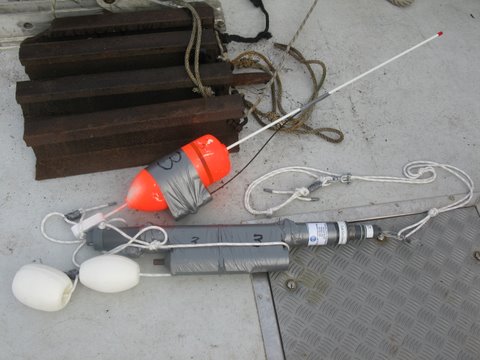
An acoustical pop-up is a cylindrical pressure housing containing an electronics payload – in this instance data recorders listening for the pings from the tagged dogfish. It a series of floats attached to the top, along with a radio transmitter for RDF locating, and are mounted to a section of railroad rail which is used as an anchor. They are deployed to the sea floor and record data for a given period of time. When it’s time to gather the data off the unit a boat goes out to the site and used a device called the Interrogator to communicate with them. A transducer attached to the Interrogator is lowered over the side, the unique ID of the desired pop-up is entered into the Interrogator and it transmits a series of commands – such as request for battery status, or distance in feet from the unit to the transducer, etc – to the popup. One command instructs the popup to generate a current that will start a chemical reaction that burns off the attachment point to the anchor (as tested in the GOT), thereby allowing the popup to raise to the surface.

During the summer of 2009 I conducted a series of dives on STL B itself – to video aquatic life that may have taken refuge on and around it. Did I mention that the thing is huge? Well, it is. And it just sits there in the water column – the top of it hovering around 90′, the bottom at 140′. On the surface there’s no sign anything is down there, with the single exception of a tiny flag attached to a 5/8″ poly line barely visible floating on the surface. That line then leads into progressively thicker line, still floating, until it finally attaches to a massive Kevlar hawser that then makes a 90 degree turn and runs straight down to the top of the STL. This Kevlar haswer costs $150,000 to replace. Side note – in 2014 a whale watch boat with 160 aboard blundered into this restricted area and sucked part of the hawser into one of her jets. More on that story:
https://www.bostonmagazine.com/news/2014/07/29/whale-watching-boat-trapped-at-sea-boston/
Here’s me sitting on the hawser…

This entire section of ocean is completely off limits to boaters – well, it’s supposed to be!. There’s a 110′ ship, the Gateway Endeavor, whose sole purpose is to patrol the area 24/7/365 a year. For me to dive the area I had to obtain security clearances, develop a very comprehensive dive plan, and present said plan to Excelerate HQ for approval. Additionally all vessels involved in the op needed to have a company observer aboard.
When a 1000′ LNG tanker needs to offload it’s cargo of LNG (re-gassify) it pulls up beside the little flag. The crew then couples the 5/8″ line to a line from inside the bow of the ship and a winch inside the ship begins to draw in the line. Eventually it picks up the Kevlar hawser and then begins to haul up the actual STL until it is completely drawn inside the ship, where hydraulic rams on the ship lock into the STL and the ship and STL become one. BTW – the “Turret” of “Submerged Turret Loader” refers to the section of the STL where the rams lock into it – this section is on bearings and is free to pivot, allowing the ship to watch and rotate due to sea and wind state. A hatch on the top of the STL is opened and the ship’s gas line is plugged in. It takes about five days to full re-gassify the LNG and transfer the ship’s contents to land, and the STL keeps it anchored in place while also providing the gas line.
Here’s a really great animation of how a STL is mated to a LNG tanker:
So I spent some dives following the Kevlar line down into blue (grey) open water to the STL, where I attached a reel to the top of the STL and rappelled down to the underside. So cool! Hanging beneath the STL I recorded video of the huge anchor rode attachments and the massive flexible gas riser – all attached to an alien underwater spacecraft (needless to say, there was no ship on it at the time).
But…
But that’s not the story. That’s just the background. This is the story…
Early fall in 2009, the day came to command the popups to, well, pop up. The Aquarium’s dive boat Lophius (bonus points for what the name refers to) went to the site and researchers used the Interrogator to command release from the anchors. All four units obeyed and responded with a Success ACK.
So the researchers waited – and waited – and guess what? Not a single unit popped to the surface. Nor did the distance between the units and the transducer change, meaning they were still laying on the bottom.
A bottom that is 280 feet down.
The next step was to enlist the use of a ROV to visit the site and the video it returned gave the answer everyone dreaded. The non-crushable floats used, well, crushed at that depth, and therefore had lost their buoyancy. Countless thousands of hours of data was trapped on the seafloor. Priceless data. The ROV didn’t have a grabber – just video. So weeks were spent trying to grapple the units from the surface – to no avail.
During one dive on STL B I asked the PI if we could bring the Interrogator with us, and we did some tests on how closely we could use it to pinpoint the location of one of the four stranded popups.

The results were promising and I felt confident I could get them, but it would require some big dives with a lot of inherent risk – and a special team to pull it off. Several high level meetings later and I was given the green light.
I was going to dive to 280′ in permanent pitch black, onto a featureless sediment bottom, to try to find a needle in a haystack…
Questions and comments always welcome!

The audiobook for Out of Hell’s Kitchen is now available, well, everywhere!

It’s a pleasure, and indeed an honor, to have Out of Hell’s Kitchen read by the incomparable narrator Philip Battley, who’s voice has brought to life innumerable characters on both the screen and the written word. He has managed to elevate my story to a level I hadn’t thought possible. Why not give it a listen and see for yourself…

On July 4th I was five days into some intensive dive training in the caves of north central Florida. Unfortunately that particular day had a less-than-desirable outcome: I ended up getting fairly seriously bent.
Long story short, I ended up getting transported to Southern Georgia Medical Center where I spent five days alternating between the ICU and a hyperbaric chamber. My wife Amy had to fly down to drive me the 1,300 miles home, after which I spent six weeks recovering. Just this past Friday I had a heart procedure that I hope is the last step in my recovery.
Though this was an intensely personal experience, I am sharing it because not only is it a somewhat interesting story, but I think it could be a some benefit to others who share a passion for diving… So if you want to hear about what happened, and why, check out this presentation I recently gave to the staff at the New England Aquarium:

~ Bella’s Song ~

Life – it washes around you like a never ending string of waves, and no matter how badly you want it to, there’s no slowing down the passage of time.
That desire was never stronger than when, several years ago, our vet informed us that our beloved goofball of a coonhound had early signs of heart disease. It was like a waking nightmare – we had lost our previous girl (Jackie) to congestive heart failure and to think of it happening to Bella was almost too much to bare.

But that’s not what this post is about. I just had to get it out – and get it out of the way – so I can instead share the important thing. A celebration of a life that has given Amy and I so much joy. A celebration of Bella…


Eight years ago we stumbled across a rescue for coonhounds called, surprisingly, CoonhoundRescue.com (this rescue’s proper name is American Black And Tan Coonhound Rescue, or ABTCR, and they are absolutely amazing – filled with amazing people who rescue amazing dogs).
We had recently lost Jackie – a black and tan coonhound mix – and the hole in our lives was tangible.
Enter Bella.
FKA Bitsy.
She was an eight month old black and tan being fostered in Atlanta by ABTCR. She was one of two survivors of a litter of B&T pups who were abandoned in Alabama. Apparently the litter was decimated by parvo – and this poor pup was also suffering from luxating patellas (dislocating knees) in both of her back legs. Oh Bella! My heart still hurts for you for the suffering your puppy life had!
So without ever meeting this future member of our family, Amy and I fell in love with her and a chilly December 10th, 2007 found us anxiously waiting at Delta Cargo.

I’ll say it again – enter Bella…
Frightened, confused, and utterly exhausted from her travels, she peered out of her shipping crate at these two complete idiots peering back at her. And it was cold out (did I mention that she was from Alabama, and we live in Boston?)


Plus, cats.
Freekin CATS!


We have two of them. Not sure if she’d ever seen those things before, but she was pretty certain she was scared to death of them. At least those first few days, but more on that in a bit.

Not only did we have cats, but even worse, we had hardwood floors – an entire sea of them. We live in a loft in Boston, a 2,000 square foot expanse of hardwood floors with a smattering of area rugs, with barely a wall or door to lessen the impact.  See, the problem was due to both her bad knees and her over-thinking brain, she knew there was NO WAY she could walk on those floors. She’d try – and then begin curling up her strong toes until she made ice skates out of them and then slowly slide her four limbs out to the four points of the compass until she was a waterbug sprawled out on the floor.

However, over the years we ended up with a string of tasteful bathmats and runners strewn literally all over the place and she would scurry from one to the other until she got to the safety of a rug. Well, unless there was, cough, a cat. Specifically Jersey. And then all caution was tossed to the wind – the chase was on. She was, after all, a coonhound.
Unless she was a waterbug, which generally was the case at the end of a good rousing Jersey chase.
(Here’s Bella vs the scary blue lines we put down when we were designing a new office)
Bella was, like I think all coonies are, a creature of habit and she developed her routes all throughout the loft. I’m sure if you traced them out it would look like the treasure map from The Goonies. (Okay – I’m going to say it – it was more like a treasure map from The Coonies… ugh, sorry).
But our home was her home – and she loved it, and we loved her. Though she had bad knees, (now’s a good point to mention that ABTCR actually had corrective surgeries done on both knees before we got her – they care that much about the animals they rescue), long walks and romps in our dog park – Peters Park – were a daily requirement (hers, not ours). She absolutely LOVED all dogs (well, she never trusted dogs that breathed funny, like bulldogs, but she still loved them). Kisses and coy paws on the shoulders were her favorite techniques. And it worked – most of the time…
Several years ago Amy was traveling for work (she has her own event planning business and works out of the loft unless she has to travel for a program) and I was laid up with my own knee surgery, so our trusted dog walker Jeff had Bella out at Peter’s Park. My cell rings, it’s Jeff…
Uh, John?
Yes. Jeff?
Yeah, uh, Bella’s been in a bit of an incident…
(my heart skips a beat)
Yes?
There was an “out of towner” in the park and she went up to him to say hello and the dog attacked her, and, uh, I’m afraid he bit a chunk of her ear off. It’s bleeding pretty badly – I’m on my way back to your place.
Oh no! Poor Bella! Poor beautiful ear! Those ears that she’s carried around in her own mouth…


… ears that you can drape across your entire face and inhale her beautiful coonie essence. Poor Bells! (<– sic – “Bells” was one of her many names, as was “Bellow” for obvious reasons for any coonhound owner).


But the amazing thing about this beautiful creature was that she never held a grudge. Never. She was ever optimistic and every dog she was convinced was going to be her new best friend. And if that wasn’t true at first, then she’d wear them down with endless kisses. Or she’d run wild – her back legs flying out in the most improbable angles, all akimbo as it were. Who could not love this dog?
Then there was one day when she began limping and we brought her in to Angell Animal Hospital (which, but the way, is quite the facility. They have a cancer wing, an MRI, and everything in between. Sadly, they knew Bella all too well…)
She had a mass in her front left paw – non-malignent, but it had destroyed the bone in one of her toes, and it had to come off – toe and all.
Poor Bella, of the bad knees, ice skate paws, and a notched ear that would make any goth kid green with envy. Now she was one toe short of a full set…

But then, a new member of the bizarre Hanzl extended family began to take shape – Sequel (for those who don’t know me, I’m an author of action / adventure action books and I’m supposed to be working on the sequel to my debut novel, Out Of Hell’s Kitchen. So as to not break any promises, Amy and I found ourselves in love with a ’06 Sabre 38 Hardtop Express – which, truth be told, has been our dream boat for about ten years. Here’s a link to the blog post where I introduce the boat, a boat that we of course aptly named Sequel. So – you know, I can truthfully say I’m working the Sequel… ).
Here she (Sequel) is during our 1,600 mile trip from Jupiter, FL to the Narragansett in RI. We spent a few days visiting my folks in Hilton Head and she (Amy) took the time to wash the boat (she’s going to kill me when she see I used this pic).

The big question was – how was Bella, the queen of instability, going to manage the unmanageable – a boat??? What were we thinking?
But Bella, in her usual amazing way, not only took the seafaring life in stride, but she embraced it. I dare say she even loved it! This is a test


Then we had “the year” – 2015.
It started pretty terribly, and it proved to be a tough one right through the summer.
See, the week before the New Year, Bella got very ill.

We thought it was just a cold, but it quickly spiraled downhill until the poor girl simply collapsed and we rushed her to the hospital. It was suspected she had an infection of the spleen, so we admitted her for IV fluids, meds, and observation, and went home to wait for news. Sure enough, not two hours later we got a call – Bella had gone into septic shock – she had a systemic infection and they would have to literally open her up to see why. We were told that she only had a 50% chance of surviving anesthesia, and the surgery would run around $8,000, and that we should think about euthanasia. We were stunned – but neither of us questioned the decision, “Please do whatever you can for her!” And then we waited and waited and waited, in quiet, desperate silence.
When the phone rang next Amy and I both literally jumped.
She had survived surgery, and they had removed necrotic tissue from the mesenteric root (W T F ???). But she was alive, and actually doing well.


She was filled with tubes – out her nose, out her neck, out her stomach – and she really had been opened from one end to the other,

This poor girl! But she was alive and she was going to heal. We visited her day and night for several days – and unknown to her, Bella developed a kind of following on Facebook as so many good people followed along in our ordeal.

And it was finally time to take her home – and boy were we all ready!

Man, what a great dog this Bella was! Her greeting was always full bodied coonie. Window rattling baying that could only bring a smile to anyone within earshot.
Because one in never enough, here’s another Bella baying – kind of a joyous scolding is the best I can describe it. In this instance I was meeting Amy and Bella at the dog park…
So that was a bad start to 2015. However, Bella got better – stronger and healthier – by the day. We’d pulled the mattress off our bed and dragged it into the living room so she could climb up and be with us, and we lived that way for weeks – camping out with our dog (and the occasional cat).
 But time marches forward, and we couldn’t escape the inevitable. While she was in the hospital the vets told us her heart was quite large and it was only a matter of time before it went into failure.
Unfortunately I’m near the end of my story. :*(

Bella’s heart kept growing and the signs of impending failure kept growing, despite literally the best possible cardiac care.
Then, at the end of June I headed down to north central Florida to do some dive training on my rebreather in the cave systems down there. While I was away Bella took a turn for the worse – it was a horrible time for my girls (Bella and Amy).
Then everything got worse. On July 4th I got pretty seriously injured – bent – while diving, and ended up being transported to Southern Georgia Medical Center where I spent five days alternating between the ICU and a hyperbaric chamber. Amy had to fly down to drive me the 1,300 miles home. (Thank you Bobeks for taking care of our poor girl during that time – I know how hard that time was for you guys too.)
It was not a good summer.
Diving Orange Grove cave system
(You can read more about what happened to me here…)
So this is it – a week after Amy got us back to Boston, we had to say goodby to Bella. I feel she had hung on just long enough for her family to be back together.
But that’s not worth dwelling on.


Amy and I – and all the people whose lives she touched – had the gift of eight amazing years with this gentle soul. Not once – not one time, never – did she so much as growl. She loved all animals – and won over even the most jaded soul. Her heart was just too big – something we always knew.

Bella – we thank you, we love you, and we miss you dearly…
John

Life After the ICW

Yes indeed, there is life after the ICW. As almost a full year has passed since our 25 day voyage, I can attest to that fact first-hand. And I’ve been itching to share them with whomever I can. But, rather than endlessly tacking on an infinite trail of entries into the ICW blog, I think this shall be the last official “ICW” post – as well as the first of the series from now on known as the “Sequel Life” series.
Sequel Life – Summer of 2014…
Boy oh boy did we enjoy our summer last year. I won’t blog you down with details of all the trips and experiences we had (heh heh!) – suffice it to say that, with my sabbatical and Amy’s flexibility with her own work, we sure did maximized our time on the boat and tacked on another 1,000 nautical miles to the 1,600 we racked up on the ICW trip. And Bella! She’s an entry unto herself (literally, stay tuned) – she took to Sequel like a, a, well like a coonhound with wonky knees and a skeptical eye towards the water would – fantastically!
Bella, Amy, and I cruised from our marina – Pirate Cove Marina in Portsmouth, RI – and explored our aquatic world every chance we got. From sunsets like no other on a beach in Menemsha on Martha’s Vineyard, to biking on Block Island – from sniffing horses’ noses (Bella did this, not Amy or I) in Greenwich Cove, to relaxing in Cuttyhunk’s inner harbor while snacking on oysters and shrimp cocktail delivered by the raw bar boat – we had so many great experiences, and Sequel brought us through them all…
Thank you boat for giving us such a great Sequel Life!
Here’s some sights and experiences from the 2014 summer. Stand by for more Sequel Life…

